
1 associated documents · 10/05/2026 · 37 · · Pinned
What a Blocksthor—Aristhor’s specialized blockchain for guarantees (or attestations)—is and is not
What a Blocksthor is, like any other blockchain
A Blocksthor is a shared digital ledger where information is recorded in a manner that is:
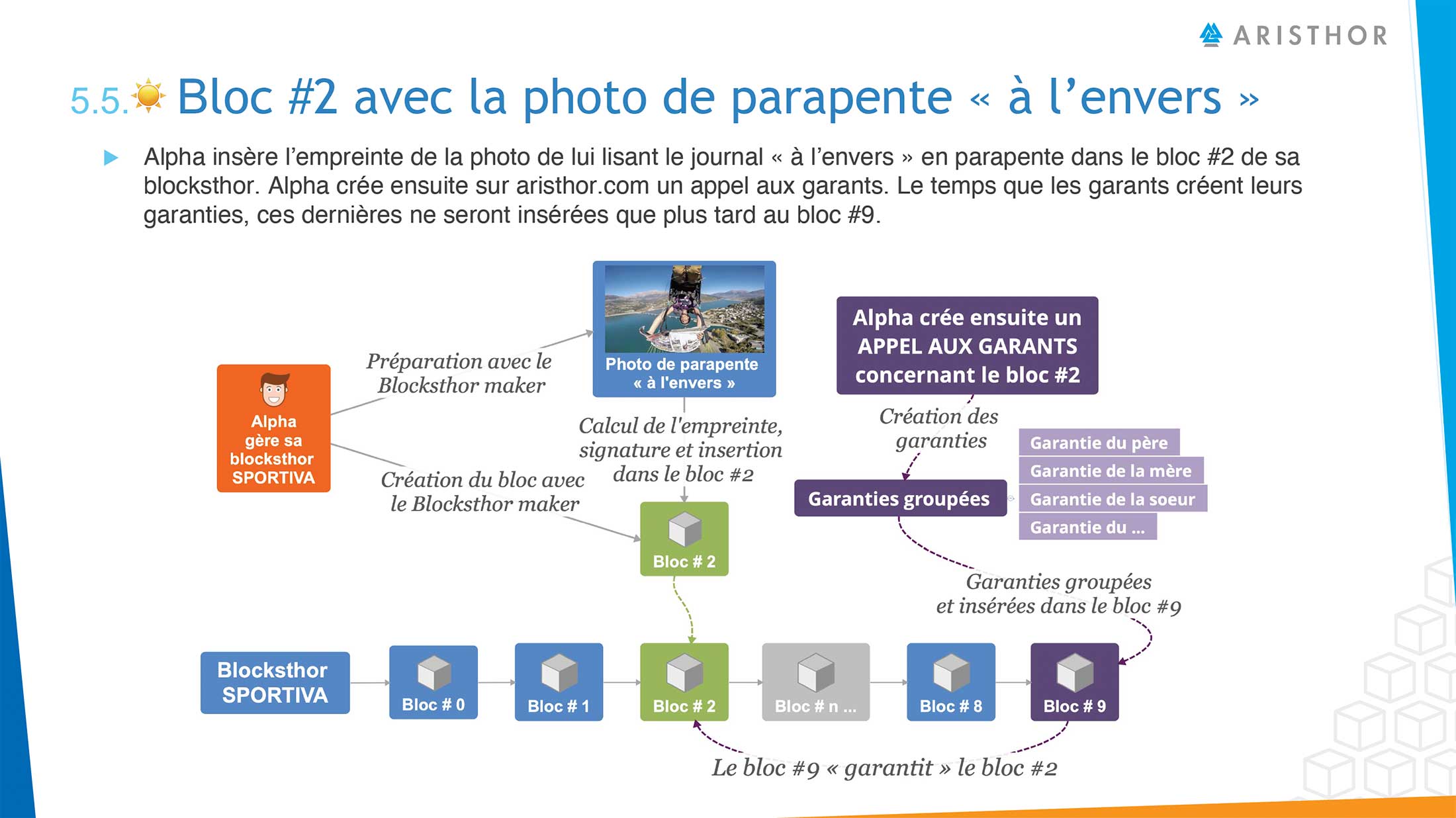
Within the Aristhor guarantee platform, the Blocksthor does not store the full content of the guarantees, but rather their cryptographic fingerprint (a "hash"). A guarantee is an attestation confirming a fact of any kind.
What a cryptographic fingerprint is
A cryptographic fingerprint of a document is a type of:
Example:
A PDF, audio, or video testimonial is converted into a unique character string (128 hexadecimal characters).
This string is recorded in a timestamped block on the Blocksthor blockchain.
Thus:
What Blocksthor offers in this context
1. Proof of prior existence
It makes it possible to demonstrate:
2. Integrity of evidence
Blocksthor acts as a "digital seal":
3. Traceability
Each entry in a block can be:
4. Decentralization
Evidence data does not rely on a single server or institution. Multiple copies are distributed.
What a blocksthor is NOT
❌ It is not a guarantee of truth
Blocksthor can prove:
but it cannot prove:
It guarantees technical integrity, not human veracity. However, the guarantor stakes their reputation on their cryptographic signature, which is comparable to a signature placed at the bottom of a paper document.
❌ It is not a magical, unlimited storage solution.
Directly storing:
on a blockchain is often:
In practice:
❌ It is not completely anonymous by default
A public Blocksthor instance may leave some traces:
Blocksthor is designed to limit these traces, but in certain cases, additional measures are required:
❌ It is not tamper-proof in the absolute sense.
A blockchain significantly reduces the risk of alteration, but:
The "garbage in, garbage out" principle still applies.
Blocksthor architecture
Outside Blocksthor (in folders)
We store everything that can be digital:
On the Blocksthor
We store:
Simple summary
A "blocksthor" is primarily used to:
It is not used to:
In conclusion
A Blocksthor is an integrity-verification and timestamping mechanism that certifies a guarantee existed in a specific form at a given moment in time.
When paired with the Aristhor.com platform, the benefits of Blocksthor extend to the easy mobilization of guarantors and the automated, decentralized distribution of the Blocksthor itself.
Any individual—or animal, object, AI, etc.—can have its own Blocksthor(s) to vouch for significant life events by inviting friends, witnesses, and guarantors to participate.
Take objects, for example: a car might change owners but retain its own Blocksthor record of every accident, modification, and repair—signed by various parties such as owners, mechanics, and drivers—who thus become guarantors of its successive "adventures."
| Preview | Document | View | Download |
|---|---|---|---|
| fr_presentation_aristhor_pdf_v1-0 | View | Download |